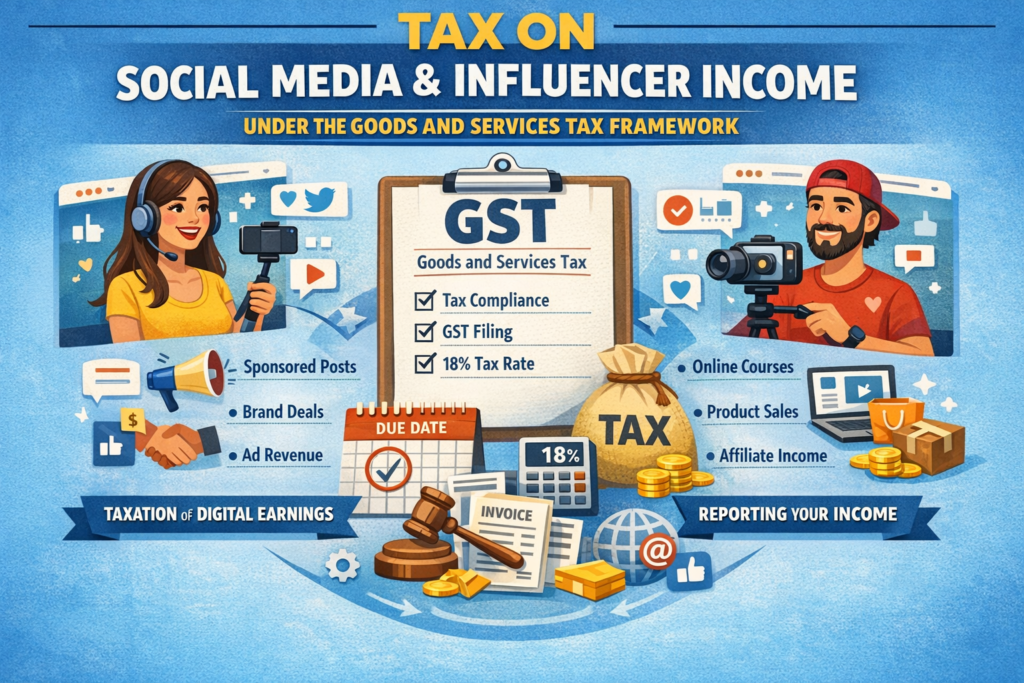
1. From Hobby to High-Stakes Business
India’s creator market has exploded into a professional frontier of over 100 million individuals. Platforms like Instagram and YouTube are no longer just social spaces; they are complex “commercial ecosystems” where a single viral Reel can generate significant revenue. But with massive influence comes massive tax responsibility. If you are monetizing your content, the taxman is no longer a passive observer—you are now a business entity in a high-stakes market.
2. The Magic Number: When Does the Taxman Start Watching?
In the eyes of the law, your “hobby” becomes a tax-liable business the moment you cross the GST registration threshold. For most creators in India, this threshold is ₹20 Lakhs in a financial year (or ₹10 Lakhs if you are based in special category states).
Many creators mistakenly believe turnover only counts cash in the bank. However, the legal definition is much broader. As per the source guidelines:
“What does turnover include? It includes all income from brand collaborations, sponsored content, ad revenue, merchandise sales, affiliate commissions, and consultation fees. Even barter collaborations where creators receive products instead of cash are included in turnover at the product’s market value.”
Failing to register once you cross this limit is a major compliance risk that can lead to heavy penalties.
3. The “Barter” Trap: Why “Free” Products Aren’t Free
The most common mistake influencers make is assuming that “product-only” deals are tax-free. Under GST law, receiving a luxury bag or a skincare kit in exchange for a shoutout is a barter transaction, classified as a “Supply of Service.” Under Rule 27 of the CGST Rules, you must pay GST based on the open market value of the item received.
CASE STUDY: The Fashion Influencer’s Out-of-Pocket Expense
Ms. C, a fashion influencer with 2 million followers, accepts a collection of luxury products from “Co. L” valued at ₹3,00,000. No cash changes hands. However, she must issue a tax invoice for the service provided:
- Service Value (Market Value of Goods): ₹3,00,000
- GST at 18%: ₹54,000
The Reality: Ms. C is now liable to pay ₹54,000 in GST to the government out of her own pocket, even though she received zero cash from the brand.
Strategist’s Tip: To avoid this “tax trap,” always include a GST Clause in your contracts. Negotiate for the brand to pay a “cash component” that covers the 18% GST liability, or ensure the brand agrees to pay the GST amount on top of the product value.
4. 18% is the Standard: Your New SAC Code Identity
Once registered, you are officially an “Advertising Professional.” Influencers typically fall under SAC Code 998361(Marketing and Advertising Services), which carries a standard GST rate of 18%.
It is vital to distinguish between Services (promoting a brand) and Goods (selling your own merch). If you sell physical products like hoodies or journals, you move into the territory of HSN codes where tax rates vary based on the product. For most of your digital influence, however, 18% is the number you must bake into every rate card.
5. The Global Loophole: Selling Digital Courses to the World
If you sell masterclasses or digital guides to a global audience, you can tap into the “Export of Service” benefit. Exports are “zero-rated,” meaning you pay 0% GST. To qualify under Section 2(6) of the IGST Act, you must satisfy five conditions:
- You (the provider) are in India.
- The recipient is outside India.
- The place of supply is outside India.
- Payment is received in convertible foreign exchange.
- You and the recipient are not merely establishments of the same person.
The CA’s Check: To stay compliant, you must file a Letter of Undertaking (LUT) to export without paying tax upfront. Most importantly, ensure you obtain a FIRC (Foreign Inward Remittance Certificate) from your bank. Without the FIRC, you cannot prove the payment was received in foreign exchange, and the tax authorities may demand the full 18% GST during an audit.
6. The Agency Triangle: Why Compliance Makes You “Hireable”
When a PR agency sits between you and a brand, the deal becomes a “triangle” of two separate supplies. You invoice the agency, and the agency invoices the brand.
Agencies rely on Input Tax Credit (ITC) to keep their margins. If you are not GST-registered or fail to file your returns, the agency cannot claim credit for the tax they paid you. This makes you a “financial liability.” In a competitive market, agencies will prioritize creators who have their GST house in order because it ensures a seamless, professional tax chain where everyone can claim their credits.
7. Conclusion: Leveling Up Your Financial Game
To transition from a viral sensation to a sustainable empire, you must “dress up” your finances as professionally as you dress for the camera. Think of yourself as the “Smart Munim” of your own brand—a modern accountant who combines business savvy with technical compliance. Just as a professional wears a suit and tie to signal authority, your GST compliance signals to major brands that you are a serious, low-risk partner.
Is your current “side-hustle” actually a tax-liable business you haven’t recognized yet? Scaling your reach is only half the battle; protecting your profits with smart tax strategy is how you truly level up.